
In October 2020 the coastal marine expedition of our Laboratory returned home.
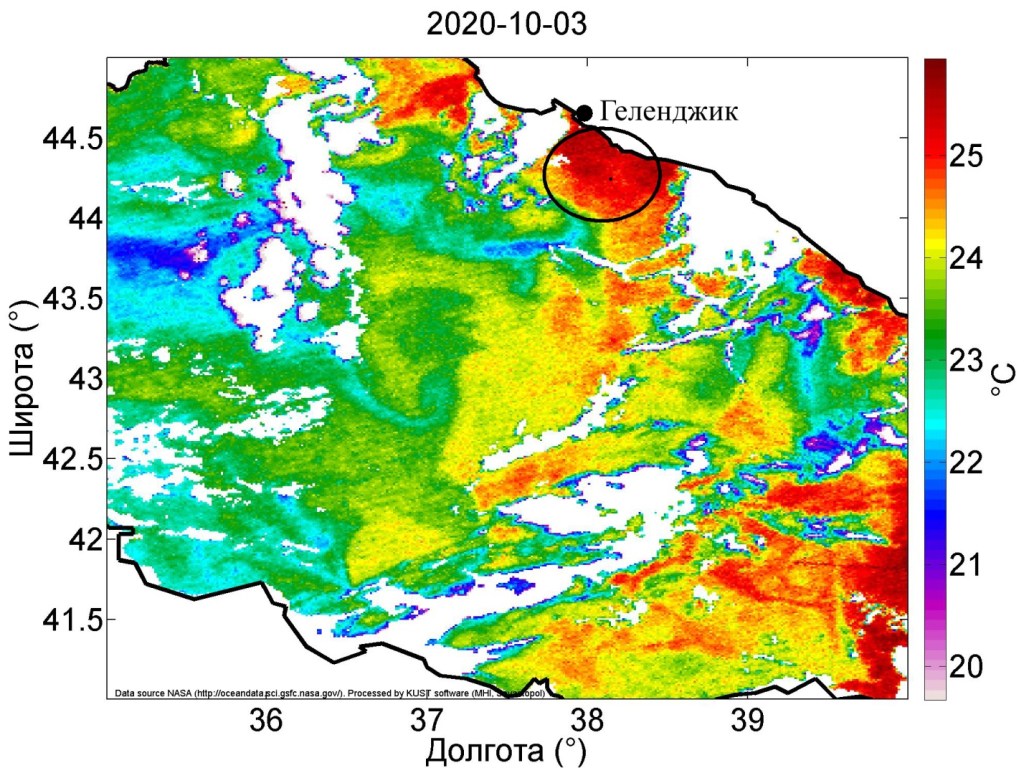
For 3 weeks the Black Sea ecosystem was studied in the area of our Institute’s stationary hydrophysical test site near Gelendzhik. This time we were lucky to study the effect of an unusual natural phenomenon. Very warm weather was observed across the whole south of Russia until mid-October, which kept water temperatures high. But the water near Gelendzhik was especially warm. If you look at the water temperature map (from MODIS-Aqua satellite data), you can see a patch of warm water (24.5 °C) 30–40 kilometres across, pressed against the coast. This points to a powerful anticyclonic water eddy that held the warm water in place. This, however, remains to be confirmed by hydrologists. To the north and south the water was much colder. As a result of this hydrophysical structure the structure of the plankton changed noticeably. The amount of phytoplankton decreased, and it consisted almost entirely of tiny (just 1 micron in diameter) cyanobacteria. Compared with a typical October, chlorophyll concentration and primary production were lower. Incredibly, the water became as transparent as it often is in the open ocean. The Secchi disk disappeared from view at a depth of 30 metres, which has not been observed in the Black Sea for many decades! Now we have to analyse the impact of this unique natural anomaly on the Black Sea ecosystem.



Leave a Reply