
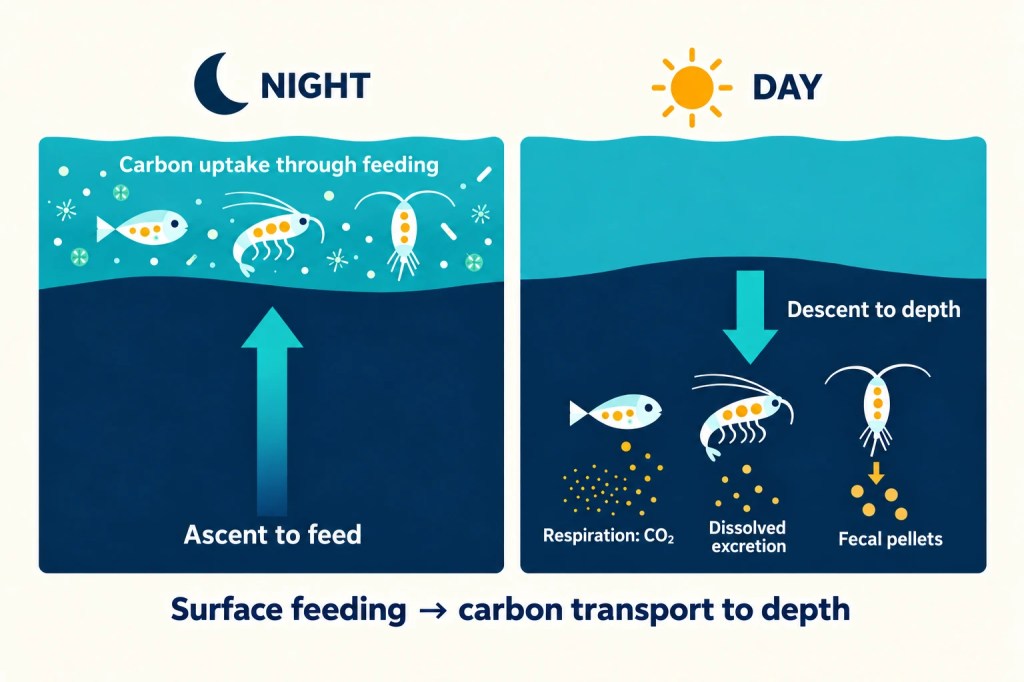
A review article by A. L. Vereshchaka has been published in the journal Diversity. It is about the vertical migrations of marine animals and their part in the carbon cycle. The topic is well known to participants in our expeditions: it is for the sake of these travellers that we have to lower plankton nets both by day and by night. The catches turn out different, and behind this difference lies a process of oceanic scale.
When darkness falls, a mass movement upwards begins in the ocean. Small crustaceans, shrimps, fish and squid rise from the depths closer to the surface, where there is more food. By morning many of them go back down: in the darkness of the depths it is easier to hide from predators that hunt by sight. In a day the animals cover tens and hundreds of metres. For a small crustacean this is quite a serious route, and there are usually no days off in the schedule.

Carbon travels together with the animals. To understand where it comes from, let us start with phytoplankton, the microscopic inhabitants of the sunlit layer of the ocean. They use carbon dioxide for photosynthesis and create organic matter. It is then passed along the food chain: some are eaten by others, those by still others. Part of this food goes to the night visitors from the depths.
Having fed at the top, the migrants take carbon with them. At depth they go on breathing, digesting food and releasing metabolic products. In respiration, carbon returns to the water as carbon dioxide, and with excretion and faeces it arrives in other forms. The animals may also become prey for deep-sea predators. In this way carbon that was recently near the surface ends up in the deep part of the food web.
The migration ladder
A single animal does not have to make the whole journey from the surface to great depths. A migrant may be eaten by a predator that then goes deeper still. In this way carbon is passed from one inhabitant of the ocean to another and can reach depths unavailable to the first traveller. The contribution of such a “migration ladder” is still hard to measure. In calculations it is also important not to count the same carbon twice: the transfer to a predator and its further fate cannot be added up as two independent inputs of carbon from the surface layer.
This mechanism is called the migratory branch of the biological carbon pump. The word “pump” is figurative here: there is, of course, no single device in the ocean. There is an enormous number of animals, each solving its own tasks: finding food and not becoming food itself. The overall result of these daily movements turns out to be important for the ocean’s carbon cycle.
Delivering lunch in time
For carbon transported in faeces it matters where the animal manages to digest what it has eaten. If dense particles, faecal pellets, form already at depth, the carbon bypasses part of the intense processing in the surface layer. Then the “package” itself matters: its size, density and sinking speed. Other animals may eat or break it up, and microorganisms may decompose it. Even the migrant’s diet affects how far the carbon eventually goes.
The review pays particular attention to who exactly makes the migrations. To estimate carbon transport it is not enough simply to weigh the whole catch. A large shrimp, a small crustacean and a fish differ in diet, metabolic rate and daytime depth. Even communities of the same total mass may transport carbon differently. That is why it is important to know the species of animals and the peculiarities of their lives.
More species does not necessarily mean more carbon transported
Different species may do similar work and partly replace each other. If one of them disappears, its contribution can sometimes be compensated by its neighbours. But the loss of a species with a special feeding or migration strategy may be far more significant. So a simple count of species is not enough: it is important to know which of them predominate and what exactly they do. The review treats this relationship as an important basis for future models, one that still has to be tested in more detail by observations and experiments.
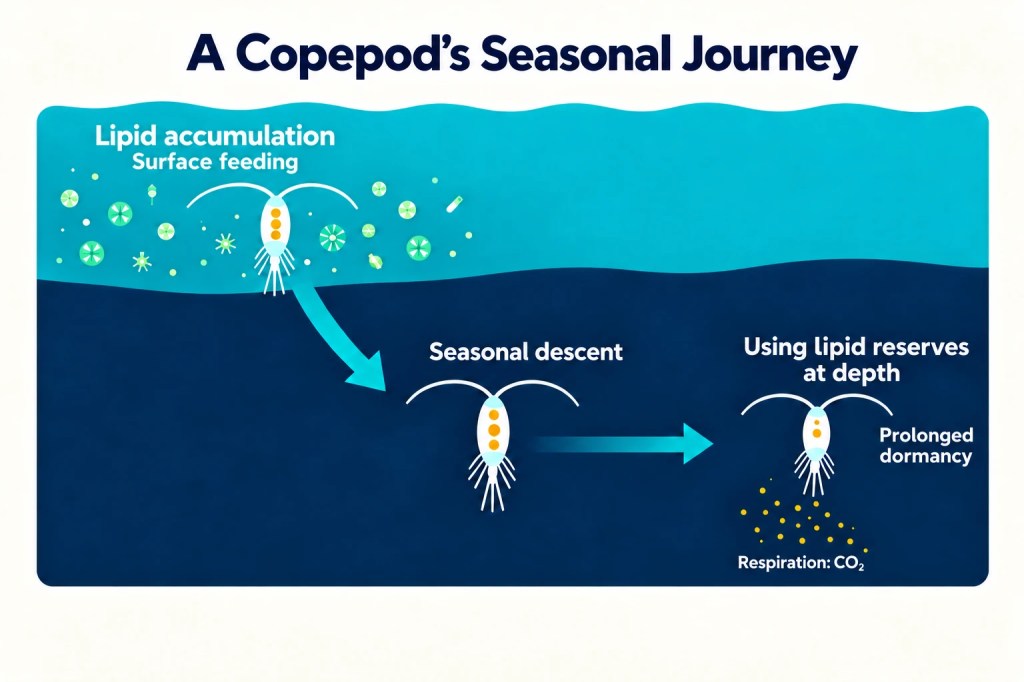
Daily journeys are not the whole story. Some crustaceans at high latitudes accumulate fat reserves during the short productive season, then go to great depth and spend a long time there in a resting state. Using up their reserves, they release carbon in deep waters. This seasonal mechanism is called the “lipid pump”.
There are also participants whose contribution is still hard to assess. For our laboratory pelagic shrimps are especially interesting. New studies show that their biomass in the deep water column of the ocean may be considerably higher than earlier estimates. However, a large shrimp biomass does not by itself give a ready answer about carbon transport. We need to find out how much they eat, how deep they migrate and how much carbon they release at depth. Between a rich catch and a reliable estimate of carbon flux there is still a lot of work.
Different instruments see a different ocean
Cameras help to observe fragile animals that are poorly preserved in nets, but they may under-count large, mobile inhabitants. Acoustics shows the movements of whole layers of animals but by itself does not give a reliable species list. DNA analysis reveals hidden diversity, but the number of sequencing reads cannot be directly converted into the mass of animals. So cameras, acoustics and molecular methods have to be combined with net catches, species identification and biomass measurement.
There is one more important detail: delivering carbon to depth is not the same as removing it from exchange with the atmosphere for a long time. Its further fate depends on depth, currents and the processes by which organic matter is reworked. Part of the carbon may return to the surface comparatively quickly, while another part will stay in deep waters much longer.
Ocean warming and changes in oxygen content and feeding conditions affect the migrants themselves. Some species change their depth of residence, others give way to neighbours with different habits. So the future performance of the carbon pump cannot be predicted from water temperature alone. We will need to know its living participants, from small crustaceans to fish and squid.
Deeper does not always mean more
A lack of oxygen pushes some animals into the upper layers and shortens the depth of their migrations. For others, tolerant of such conditions, low-oxygen waters may serve as a refuge from predators. But in these conditions metabolism may slow down: the animal stays deep, and releases less carbon by respiration. A change in migration depth does not by itself show whether carbon transport will strengthen or weaken.
The ocean is also very heterogeneous. In polar waters seasonal migrations and the accumulation of fat reserves are especially important; in warm, nutrient-poor regions both the food webs and the migrants’ metabolism are arranged differently. A universal coefficient that would allow carbon transport in any region to be calculated from the mass of the catch is hardly to be expected.
Why there is no single spectacular figure here
Published estimates of the migrants’ contribution differ greatly. In part this reflects real differences between regions, but the studies also cover different seasons, use different methods and count the flux across different depth boundaries. So percentages from different works cannot be compared with each other, or extended to the whole ocean, without caveats.
For us this is one more reason to examine day and night catches carefully. Behind every identified species and every biomass estimate lies a chance to understand better how life in the ocean is connected with its role in the Earth’s climate system.

Paper: Vereshchaka A. Biodiversity in Motion: How Marine Diversity Shapes the Ocean’s Active Carbon Pump. Diversity, 2026, 18, 549.
This work was supported by the Russian Science Foundation grant No. 25-77-30002 and by the state assignment FMWE-2024-0023.


Leave a Reply