
From 14 June to 28 August 2021 the 118th cruise of the flagship of the Russian research fleet in the Black Sea, the R/V Professor Vodyanitsky, took place. It was carried out by the Shirshov Institute of Oceanology of the Russian Academy of Sciences (IO RAS) with the participation of the Institute of Biology of the Southern Seas and the Marine Hydrophysical Institute of the Russian Academy of Sciences. The main aim of the cruise was to study the role of short-period and mesoscale physical processes in shaping the structure of the plankton and the biological productivity of the Black Sea. It is becoming evident that the role of these processes in the functioning of marine ecosystems is much greater than was thought earlier. The main task was to find mesoscale hydrophysical structures and to study their effect on the biological components of the ecosystem.
It should be noted that 2021 was quite unusual in terms of mesoscale water dynamics and the general circulation of the Black Sea. As a rule, by early summer the Rim Current weakens, meanders and generates a series of anticyclonic eddies. So in August, mainly eddy structures with anticyclonic vorticity are observed in the deep part of the sea. But in 2021, throughout May and almost all of June, strong winds with cyclonic vorticity blew almost without a break, which strengthened the Rim Current almost to its winter–spring state. Analysis of satellite altimetry data, supported by CTD soundings, established that in August 2021 the water circulation in the northern part of the Black Sea, and the vertical and horizontal distribution of hydrological parameters, were anomalous, not typical for the warm season. The Rim Current was intense and pressed against the continental slope, and the mesoscale anticyclonic eddies typical of summer in the deep part of the sea were absent. Instead, pronounced mesoscale cyclonic gyres 40–60 kilometres in diameter were observed. They were clearly visible on the sea level map (Fig. 1). Against the background of an extensive cyclonic zone, the “caps” of mesoscale cyclonic eddies could be seen.
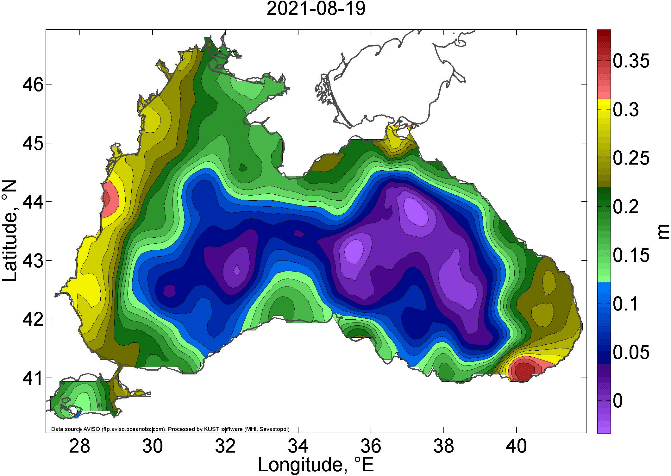
Fig. 1. Dynamic topography of the Black Sea level on 19 August 2021. Violet areas correspond to the position of cyclonic eddies.
Before the start of the expedition it was known that a hurricane-type atmospheric cyclone, compact and with high wind speeds, had settled over the north-eastern part of the sea (Fig. 2). It became famous for flooding Kerch and Anapa with rainfall.
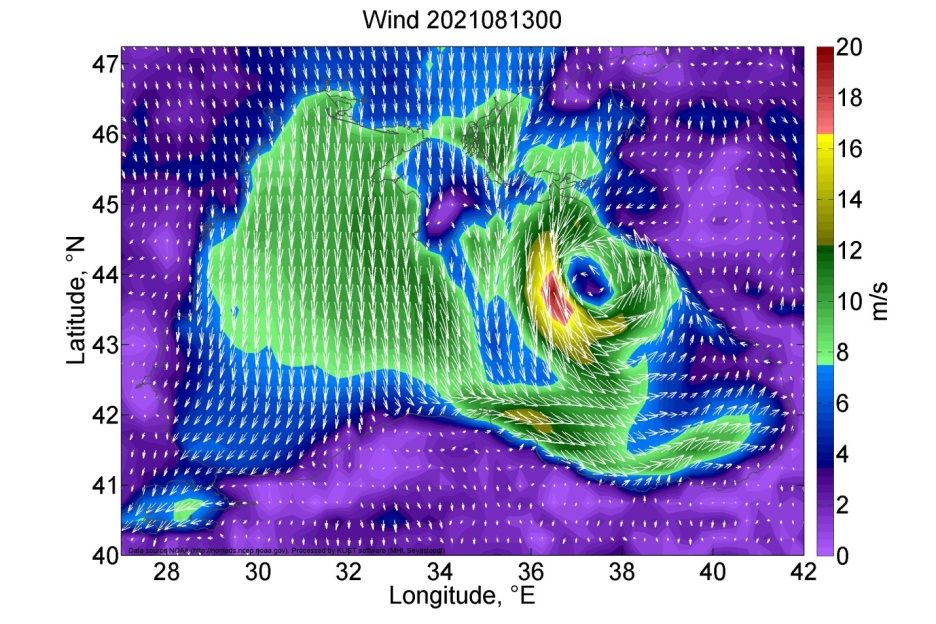
Fig. 2. Wind conditions before the start of work, 13 August 00:00.
At the site of its “eye” it initiated a powerful mesoscale eddy in the sea, which caused an upwelling of deep waters and their mixing with surface waters. As a result, at the centre of the eddy the surface water temperature fell by 3–4 degrees compared with the background (Fig. 3).
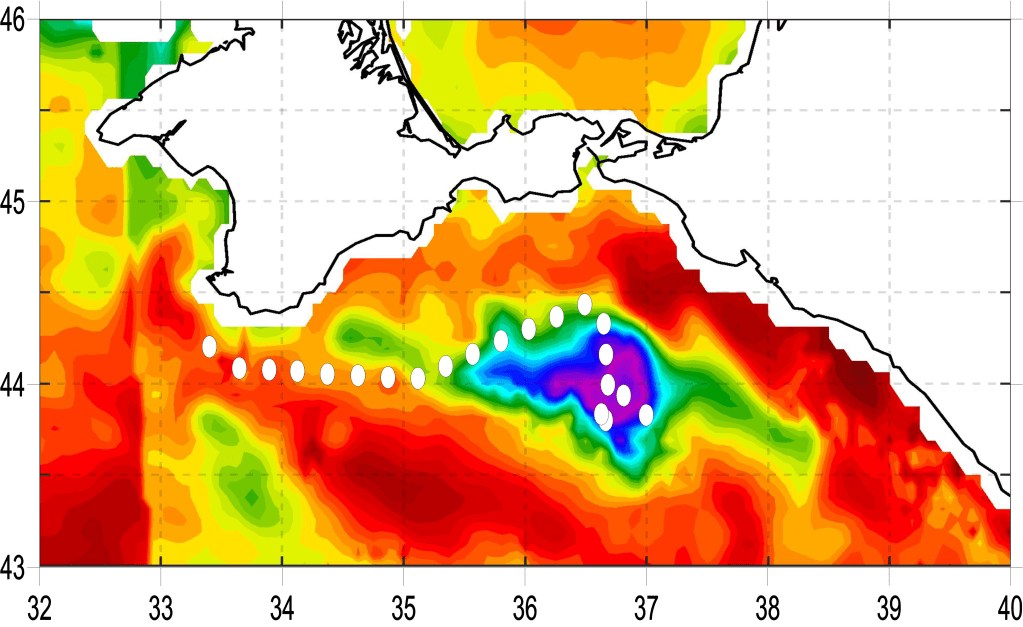
Fig. 3. Cruise track and stations on 15–20 August 2021 against the satellite sea surface temperature for 18 August.
The expedition was planned so as to study the cyclonic and anticyclonic zones of vorticity of the current field. On departure the vessel made a section across the central cyclonic vorticity zone. The vessel then turned south to carry out studies in the cold water patch at the centre of an intense cyclonic eddy. Indeed, as expected, a very high position of the main pycnocline (38 m) was recorded there. The vessel then made a section in the zone of anticyclonic vorticity of the current field near the North Caucasus, where the Rim Current was characterised by a very high current speed, up to 50 cm/s. Its capture of shelf water and the strong turbulence of the water promoted high biological productivity, expressed in high concentrations of chlorophyll a and a highly productive layer stretched over depth.
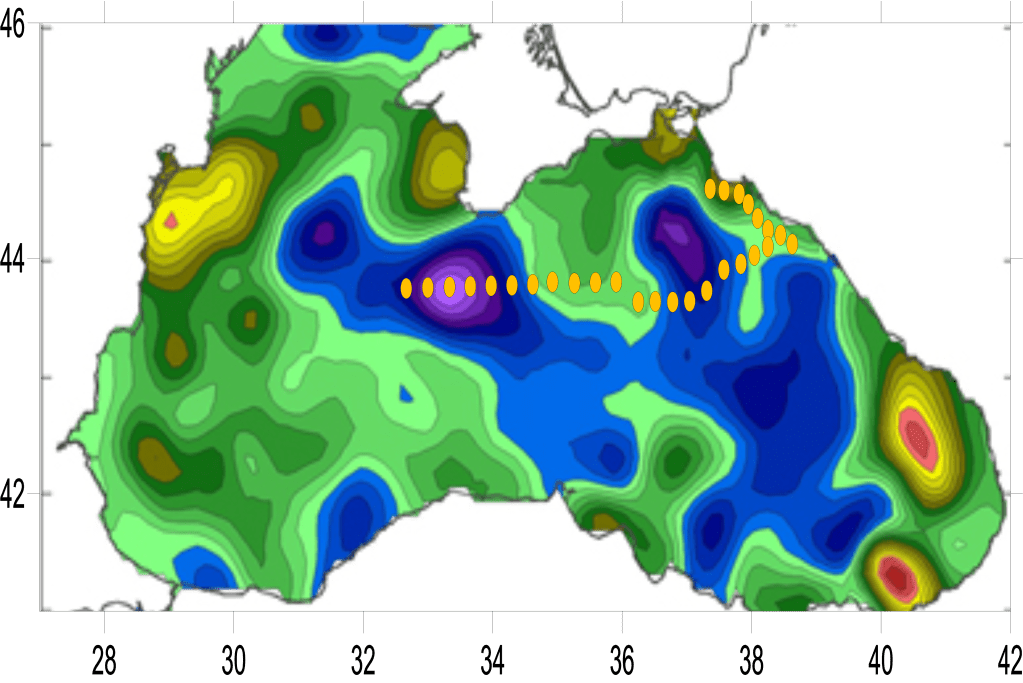
Fig. 4. Cruise track and stations on 21–27 August 2021 against the dynamic topography of the sea level for 21 August.
The vessel then proceeded to a latitudinal section across the central zone of cyclonic vorticity of the current field (Fig. 4), where biological productivity was also higher than in a usual summer. The ship’s route was deliberately laid so as to study once more the intense cyclonic eddy under the cold patch. At its periphery biological productivity rose, as expected. The vessel then headed west to study another, newly formed cyclonic eddy (longitude 33°), where a position of the 16.2 sigma-t isopycnal at a depth of 88 m, a record for summer, was recorded.
In total, during the cruise 74 CTD soundings were made with a rosette of 10-litre bottles and 49 LADCP soundings. On transits (51 legs) continuous measurements of temperature, salinity and oxygen concentration were made. At 23 stations layered zooplankton net hauls were made (126 hauls), and at 16 stations macrozooplankton hauls (16 hauls). More than 300 samples for chemical analyses and numerous biological determinations were taken from the sounder’s bottles. As a result of the prevailing hydrodynamic situation the primary productivity of the basin turned out to be unusually high. In the upper layer, 0–30 m, the main nutrients had by the time of the cruise already been used up by phytoplankton. Nevertheless, a preliminary estimate of phytoplankton biomass, made from chlorophyll a fluorescence, showed high values precisely in the Rim Current zone, where anticyclonic eddy dynamics drew nutrient-rich shelf waters into the flow. In addition, the strong current (up to 50 cm/s) created increased turbulence, which promoted the vertical flux of deep nutrients. In the rest of the deep-water part of the basin studied, chlorophyll a values were lower than in the Rim Current, but higher than in a usual year in summer. In the cyclonic gyres an increased deep chlorophyll a peak was observed, indicating the development of shade-loving algae. Thus both the anticyclonic vorticity and the mesoscale cyclonic eddies contributed to a significant increase in biological productivity. The results obtained clearly demonstrate the important role of mesoscale hydrodynamic structures in the functioning of the Black Sea ecosystem.
The expedition was carried out with the financial support of the Ministry of Science and Higher Education of the Russian Federation, RSF grant 20-17-00167 and, in part, within the topic of RFBR project 20-05-00068.



Leave a Reply