


So, the first and longest part of the expedition is done. We have taken 8 deep-sea stations (24 samples in the 0–200, 200–1000 and 1000–1500 m layers) and one shallow training station (0–50 m).
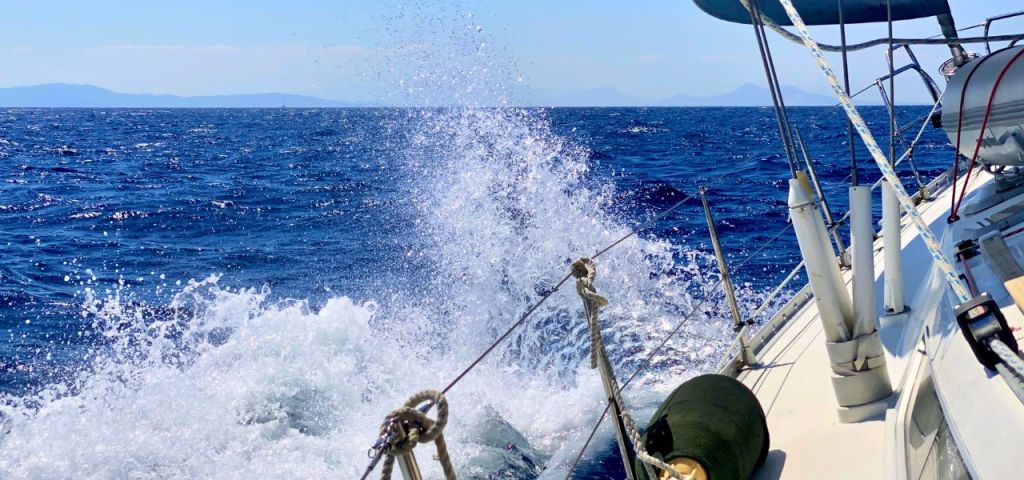
The main conclusion: it is possible, and necessary, to work from a yacht! The key to success is a motivated crew, because the main burden falls on them. The sturdy steel structures, A-frames and hydraulic winches of a large ship are replaced here by a system of halyards and sheets, the standard capstan (instead of a winch) and a drum for winding the line. A line, not a wire rope: wire is deadly for yacht blocks, so for our purposes we bought a special non-stretch line 1500 m long. The net is hauled at 0.8 m/s, just as in the best houses of Paris.
Technical details in brief: the line can quite well be kept vertical even with a drift of 1.5 knots, all the changes of rigging are made by the crew quickly and flawlessly, and the creativity in using stays and carabiners is impressive: sailing skills and a mountaineering past turned out to be extremely useful. Photographs of the big net, more than 6 m long, stretched out under sail, will in due course impress you. Unlike on big ships, where we had to invent something to suspend the net, here everything is simple, since the 23.5 m height of the mast is more than enough for any manoeuvre. The softness of the line, and its careful paying out and hauling in, meant that we collected the samples without failures. There was not a single false triggering of the closing mechanism even in a strong swell, a result a big ship might envy.
The weather limits turned out to be almost the same as for a big ship. We avoid cyclones and strong-wind zones, but in those areas even from a big ship large Bogorov–Rass nets cannot be used in bad weather. With wind up to 10 m/s and drift up to 1.5 knots the net is hung out over the side and lowered and raised successfully. With wind up to 5 m/s the work becomes a pleasure.
The only drawback of a small vessel is that small animals cannot be identified, because the ship is always rolling (at least for the two weeks we have been here). But something preliminary can already be reported.
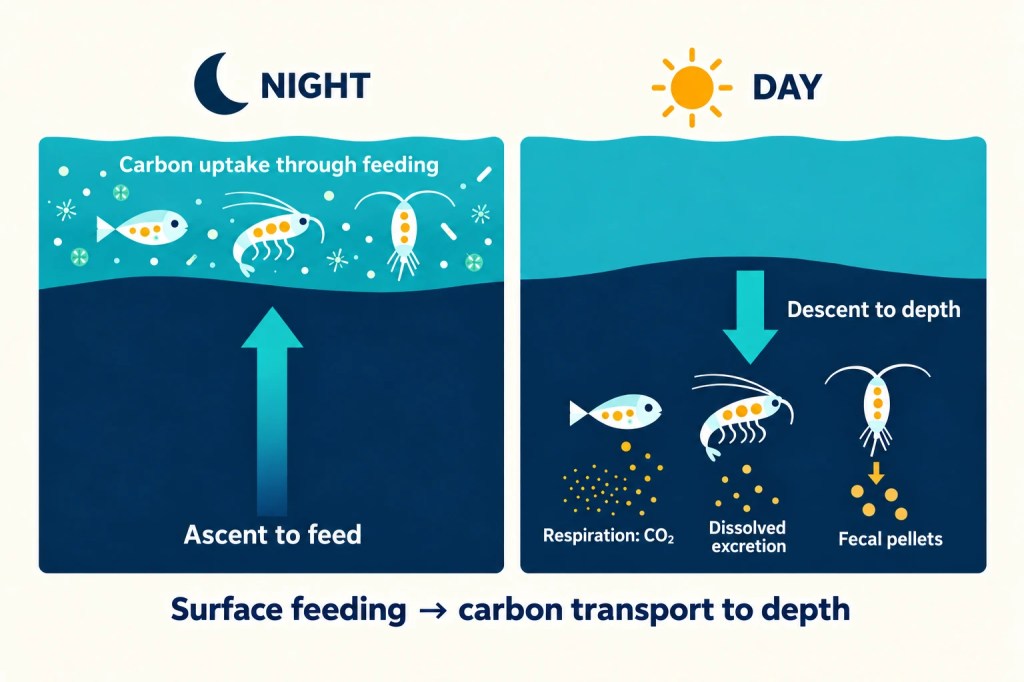
1. We are working in very poor waters, so there is little plankton. We work at night in order to “catch” the plankton communities during their nocturnal upward migrations and to obtain data comparable with the Atlantic. In the 0–200 m layer there are mainly gelatinous forms (tunicates, siphonophores, medusae) and copepods with a rare admixture of chaetognaths and euphausiids. In the 200–1000 m layer biomass and diversity are at their maximum, dominated by copepods, shrimps, euphausiids and chaetognaths. In the 1000–1500 m layer there is very little plankton, mostly deep-sea copepods, with Cyclothone occasionally appearing; once the whole sample jar was filled with a deep-sea octopus so rare that we could not identify it with Nesis’s key.
2. The hypothesis that matured in the Atlantic, that the role of deep-sea shrimps is radically underestimated, is confirmed. At all stations but one we found 1–4 large shrimps (3–5 g each) and several small ones. Everywhere between South Africa and Madagascar two species dominate: Acanthephyra quadrispinosa and Systellaspis debilis. Their biomass is no less than the biomass of all the rest of the net plankton.
3. Biomass (so far visual estimates) and species composition are remarkably constant along the transect. We would like some variety at last: new large shrimps, euphausiids and the rest.
Interim result: the cruise has exceeded all expectations. For the first time, deep-sea hauls down to 1500 m with a large net have been made under sail, and new representative data have been obtained that will allow a more accurate assessment of the biological resources and biodiversity of the ocean. In two weeks we have done as much as we sometimes did in a month on a large vessel. And not in the Atlantic, but where plankton was last collected in 1988 (and when it will be collected next is unknown). The nets are (touch wood) working without failures so far. This opens fundamentally new possibilities for work in interesting but remote areas of the World Ocean on non-specialised vessels. Specialised ships are hardly likely to be sent here (pardon the pun); they would rather be packed to the maximum and, to PR fanfare, make their hundredth trip around the long-suffering Arctic.
We have a different path: two RSF grants made it possible to carry out a month-long expedition, independent of science bureaucrats, to a most interesting area at the price of two ship-days of a large vessel. A toast to the RSF and to the fair distribution of grants in that foundation! In a day we will reach the southern coast of Madagascar, where we will wait out a cyclone for a day. Then the last dash to Mauritius and the journey home.



Leave a Reply