
Part 1. How the 2nd cruise of the yacht “Basileus” became the 1st cruise of the yacht “Amazon”
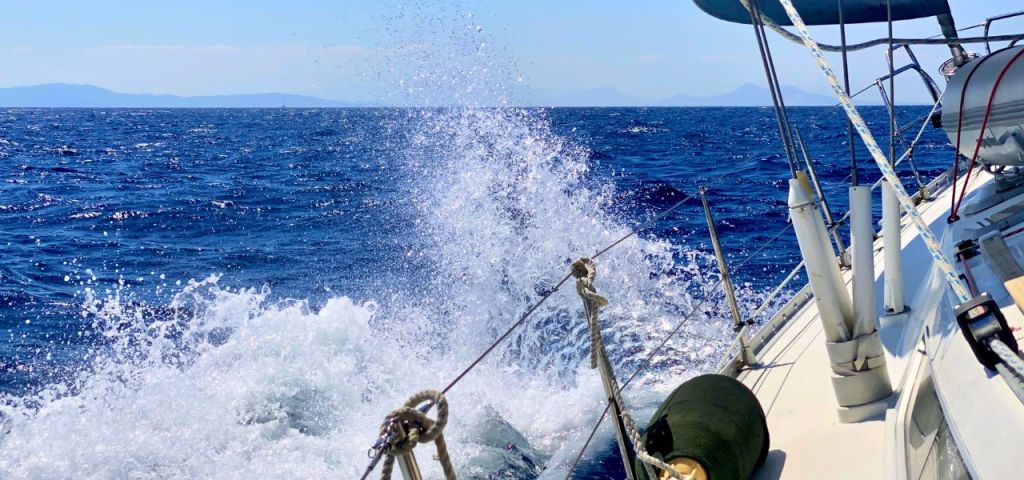
The expedition began briskly and cheerfully. First of all, it turned out that the yacht “Basileus”, on which we had planned to sail from Cape Verde, stayed in the Azores, and instead we were going on a proper two-masted gaff schooner, the “Amazon”. It is a very convincing machine with two masts and serious sail armament: two jibs, a staysail, a foresail (with a topsail above it) and a triangular mainsail. The schooner displaces almost 200 tonnes (instead of the 50 planned), comparable to Columbus’s flagship “Santa María”, except that instead of 40 men and cannon there were 15 of us, armed with two plankton nets. Another vessel of similar size we know from childhood: the “Duncan” of Lord Glenarvan from In Search of the Castaways.


The flip side of the more comfortable conditions was the lack of the necessary equipment aboard the schooner, since the winch and the one-and-a-half-kilometre line for deep hauls stayed in the Azores together with “Basileus”. The captain of the schooner and we had optimistic plans to buy a line and a winch in Cape Verde, where a week of repairs of the “Amazon” was planned before departure. The shipyard and the large yacht marina (Mindelo is a stopover for yachts crossing the Atlantic) gave us hope that installing new equipment would be no trouble. Our hopes were only half justified: the yard made the winch, but there was no suitable non-stretch line in the Cape Verde Islands at all. Not a single metre. And we had already flown out of Moscow.
It should be noted here that one of the expedition members, Yana (A.A. Lunina), has godparents in Portugal. Since all roads to Cape Verde (a former Portuguese colony) lead through Lisbon, Yana decided to fly out a day earlier and spend it with her relatives: her Schengen visa was expiring and future trips to Europe looked uncertain. Having arrived in Portugal, Yana spent an unforgettable day with her godparents: she explored all the yachting shops of the capital and bought up all the line available. What also saved us was that Portuguese is the native language of Yana’s relatives, who have lived in Lisbon for the last fifty years. Without that, finding the shops and negotiating with the sellers would have been doomed to failure (and we had only one day in hand).
When we arrived in Lisbon the next day with Vladimir Ivanovich (Gagarin), the third member of the expedition, in addition to our luggage we found eight lengths of line on rather bulky spools. The exact total length of the line was unknown (in Portugal it is sold by weight), but it was known for certain that this was all the line there was in the Portuguese capital. Of course, there was the problem of transporting all this to Cape Verde, but at that moment we did not yet understand the full depth of the problem. We simply rewound the line so as to get five fully wound spools, each weighing about twenty kilograms. That was how our day in Lisbon went. Incidentally, fate gave us that day, because the flight to Cape Verde was postponed by almost a day.
Moreover, the departure was postponed to 3 a.m. At midnight we arrived at the airport with our expedition luggage at the limit of the permitted weight and with five twenty-kilogram spools, where it turned out that the flight had been delayed once more, now until 5 a.m. Ours was not the only flight delayed. Meanwhile, access through security to the halls with seats, where one could at least settle somehow, was closed. Those few hours added to our experience: we learned to lie and sit on stone ledges in the narrow gaps between passengers of all the colours of the rainbow.
Our wait was brightened by the fact that only one check-in desk was working, and each passenger took 10–15 minutes to check in. We stood like that for about an hour. When our turn came, they processed the 5 spools as excess baggage without problems and asked us to pay a mere 450 euros (recall that the total weight was about 100 kg). After a slight shock we expressed readiness to pay (what else could we do? the expedition was only beginning and there was still money). We were offered a payment terminal and were very surprised that we could not pay by card. We explained at length (remember, in Portugal it is Portuguese that is in use, and other languages are very poorly understood) that we were from Russia and our cards were cut off from SWIFT, and we were told at length that the only place that accepts cash would open in the morning, after our plane had departed. The situation became a stalemate…
Suddenly a night angel descended upon the girl (who else could it have been, and at such an hour), she brightened up, abruptly cancelled our baggage payment slips and checked in three of the five spools as ordinary baggage, in addition to our own, which had already vanished into the depths of the conveyor. How she managed it is a Portuguese official secret. The remaining two spools Gagarin and I smuggled through as hand luggage.

Then we flew for five hours and landed at the Cesária Évora Airport (yes, the famous singer was born in Mindelo). We were met, and it turned out that the departure of the schooner was postponed. It was all due to the general tropical unhurriedness of the dock workers. At night the schooner glowed like a Christmas tree: the crew, trying to finish sooner, worked in place of the Black dockers. How they worked during the day is hard to imagine, since the temperature in the shade was 30 degrees and one could bake pies inside the schooner standing on the shore, red-hot in the sun. In the end the yacht was ready to depart on 23 October (instead of the planned 20 October). As a parting gift the cheerful African dockers demanded an extra bonus, which the captain had not counted on. The group of scientists came to the rescue (the expedition was only beginning and there was still money).



Leave a Reply