
Part 3. Is it worth the trouble?
At this point, or perhaps earlier, the reader will ask: why can we not go on specially equipped vessels, where the conditions are more familiar and where there is no need to look for trouble?
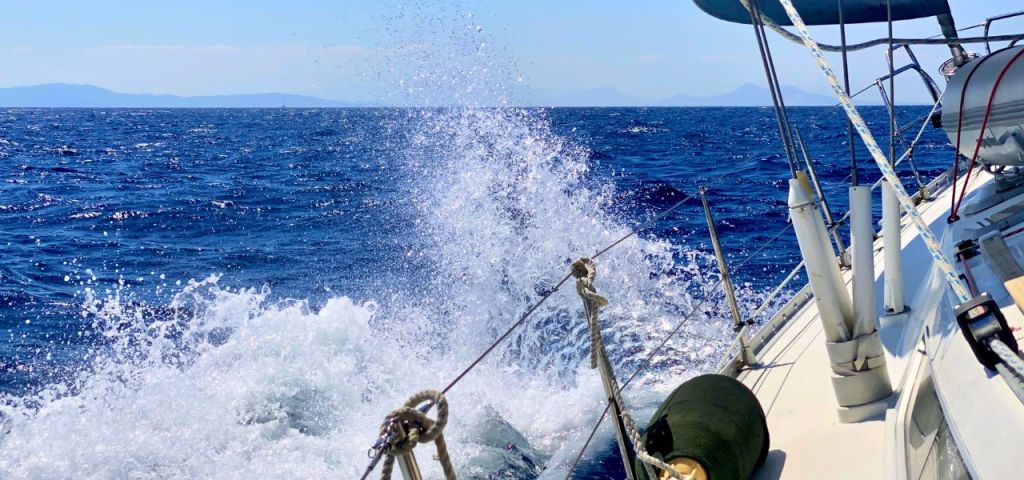
First, the overwhelming majority of marine expeditions supported by the Ministry of Science and Higher Education are devoted to the study of the Arctic Ocean. Even taking into account the central deep-sea basin (which is far from always visited!), this is just over 1% of the volume of the World Ocean. A strategically important region, but objectively an insignificant part of the World Ocean. The real World Ocean, with its true volume and depths, lies where you have to sail for several weeks in one direction and as many back, and it is this that oceanographers should study first of all. Such cruises are very expensive, and the state ever more rarely supports even voyages to the tropical and South Atlantic. What can one say of the Indian, Pacific and Southern Oceans! On sailing ships, which go practically everywhere, such regions can be visited. The main thing is to agree with the crew and choose a suitable route.


Second, in present conditions a cruise to remote regions is hardly compatible with Russian vessels calling at foreign ports. So the participants of the expedition, even if such a cruise took place, would have to spend many months aboard. Not everyone can afford that: work, grants, personal circumstances. Sailing ships, by contrast, usually sail under the flags of other states and have no problems calling at foreign ports. You can fly to the port of departure and fly home from the end point of the route, which adds up to about a month in total.
Third, it is romantic! We were all children, and many of us dreamed of the sea and adventure. And the best adventures are at sea, and the best sea adventures are on a sailing ship. Fortunately they end well and only the best is remembered. And there is rapture in this: to live and work at the junction of two elements, two oceans, the air and the sea. Your mood changes, your view of life changes, and work at sea, and then its continuation on land, becomes a joy.
Finally, as for looking for trouble. In order not to grow old, you must constantly solve new problems, take new paths, and meet new, unconventional, energetic people. A sailing ship will provide all of this, and even the problems we met this time with the unexpected change of vessel only prolonged our youth. Science should be done briskly, cheerfully and unconventionally. Then it will not only give pleasure but also bring world-class results.

We will certainly never be like this again. And you?
We are grateful to:
The company Rusark, its leader Dan Gavrilov and the crew of the “Amazon”, for the professional solution of both usual and unusual problems;
The Director of the Institute of Oceanology A.V. Sokov and the head of the Legal Department D.M. Ivanov, for legal and moral support of our undertakings;
Our colleagues A.A. Vedenin and D.N. Kulagin, for the timely and painstaking arrangements for our return (prompt ordering and payment of tickets and accommodation).



Leave a Reply