
Part 2. In the tropical ocean.

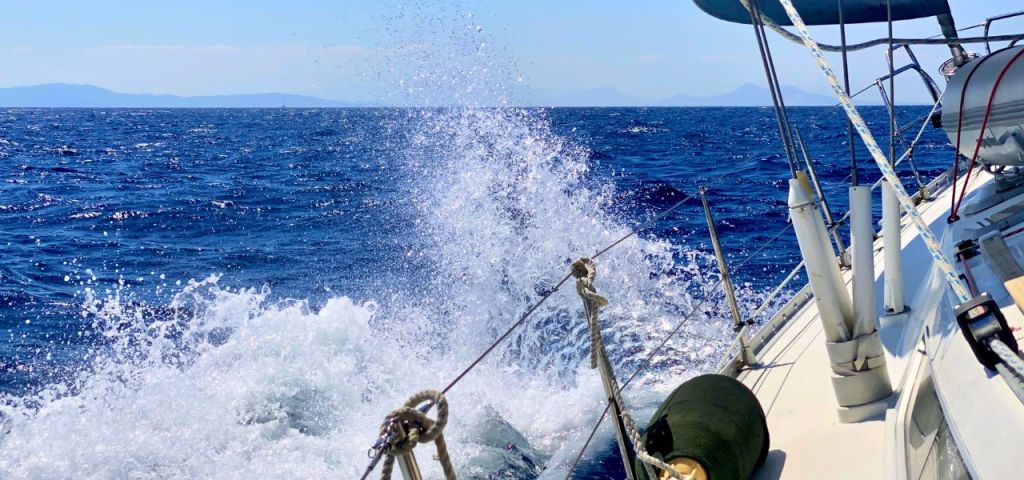
A force-3 gale and a wind of 10–15 m/s were our pilots as we left the bay of Mindelo. It was surprising that, despite its small size compared with the “academician” ships Vavilov, Ioffe and Keldysh (200 tonnes instead of 6–7 thousand), the schooner went confidently through the waves, though the rolling was much stronger than on the big white ships we are used to. On the second day we did the familiar thing, mounting the plankton net, and the less familiar one, marking the line. The line turned out to be 1070 m long; we put marks at the places to which the wire had to be paid out and where the weight had to be dropped. In the end we decided to sample the epipelagic (0–200 m) and the mesopelagic (200–1000 m).

The multicoloured pieces of line later pleasantly varied the routine of lowering and raising the net and warned us at what depth our fishing gear was. It should be said that in the end five pieces were put to use, which the captain conscientiously joined with splices that did not in the least hinder the passage of the messenger weight (used to close the net at the desired horizon). Because there was no spool for winding the line (recall that it stayed on the other vessel), the question stood in full height: how to lay out a kilometre of line on deck without tangling it? In the end we decided to wind the line onto two pegs: with 3 m between them we got 170 full turns. As a weight we took a bundle of divers’ weights and a gymnastic kettlebell.


It was not easy to find a place to lower the net. Despite the schooner’s solid size, the space above the deck is taken up by shrouds, stays, sheets, halyards, downhauls and other running rigging, and of course the sails themselves. In the end we found a place on the forecastle in front of the first mast, the foremast. The lowering block was tied to the staysail boom, swung out to starboard, the winch was set up in the centre, and the wound line was placed along the port side. And the time came to try what we had made. The sails were lowered, the deck crew led by the first mate and we took our places at the rail, and the captain stood on the bridge. At the first station the wire went into the water vertically and the samples were collected without problems. And then the trade winds blew…


Here it must be said that for representative sampling at great depths and in poor (oligotrophic) regions of the ocean we use the Bogorov–Rass net. It is a solid piece of equipment almost 9 m long (assembled) and almost one and a half metres in diameter at its wide part. So at a wind of 10 m/s or more it is hard to work with it even on big research vessels. First, lifting the net into the air and putting it over the side without damage is quite difficult: it turns into a sail that lives its own hard-to-control life. Second, while the net is being lowered to a great depth, the vessel drifts away from it so fast that it becomes impossible to compensate for this drift so that the wire goes down vertically. So in such weather, do not expect good quantitative sampling. As a result, in the equatorial zone our schooner, spreading all her sails, ran at 8–9 knots (in a wind of 10–12 m/s), racing over shoals of deep-sea shrimps and happy mesoplankton that never knew a scientific test tube. At night pyrosomes bounced off the stem like infernal light bulbs…
All the same, we lowered the sails three times, lay to, and made 3 stations. The line went over the side at an angle of 45 degrees, so there was no thinking of quantitative hauls. But we did manage to catch plankton for faunistic and molecular genetic analyses; these parts of the ocean are not visited often, and less and less each year.
Finally, around 10 degrees south, the wind died, the sails were lowered, and the schooner, unhurriedly, under engine, glided into the southern oligotrophic gyre. Here our patience was rewarded: we made 7 stations in a wind of 4–6 m/s with the wire going almost vertically into the water. The last station was taken at the latitude of Rio de Janeiro (almost the southern tropic), and two days later we reached the finish, the Brazilian port of Itajaí.
The return journey turned out to be a reward for our adventures on the way to Cape Verde. The only inconvenience was the impossibility of changing money in the resort town of Itajaí, where everyone is used to paying by card. Our arrival was processed in the evening, and the next day was Brazilian Independence Day, 15 November. Our flight included a day in Rio de Janeiro, where we remembered Ipanema, Copacabana, caipirinha, cachaça and plunged into the atmosphere of the most carnival city in the world. Moscow greeted us with frozen ponds under the wing of the plane, a little snow and a bracing minus.


Leave a Reply